Here’s a Guide to How Much RAM Your Laptop Needs | Laptop Mag
How much RAM practise I need?
"How much RAM practice I demand?" It'south ane of the most frequent questions asked past anyone buying or upgrading a desktop or laptop, and while there are some reasonable stock answers that people usually share, there is no one-size-fits-all respond, and very little of the advice you do see has any real testing to back it upwardly.
We're here to fix that. By testing a multifariousness of use cases on dissimilar amounts of RAM, we can get a very expert idea what sort of uses tin can exist comfortably washed with how much RAM, and even give yous an thought of how you can stretch the RAM you've got.
What is RAM and how does it work?
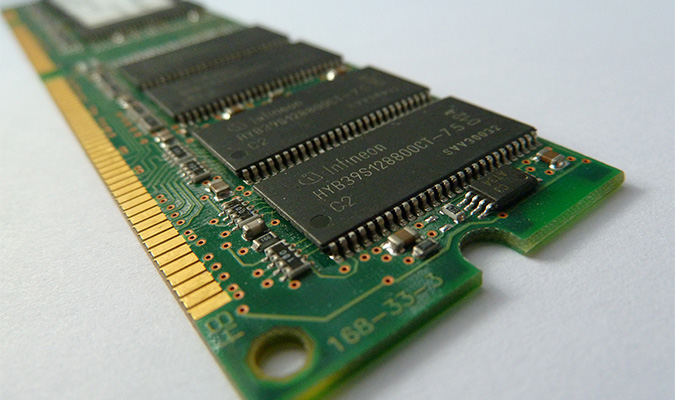
Let's first with the about basic elements of the question. RAM is where data is stored before processing. RAM stands for Random Access Memory, and it consists of dynamic memory chips that tin be written and rewritten with data very chop-chop. Unlike your hard bulldoze, however, the memory used for RAM is too volatile, pregnant that it only holds onto that information while the flake is powered, so it'south not designed to hold information long term.
Substantially, RAM is the memory that really lets you work with the data needed to run programs and open up files. Whenever your figurer loads a program or opens a file, it opens upwards that data in RAM. Even your operating system uses RAM when information technology'due south running. If you lot want to run a programme, it pulls the information from long-term storage on your hard drive to short-term storage in RAM, where it can be accessed quickly enough for smooth operation.
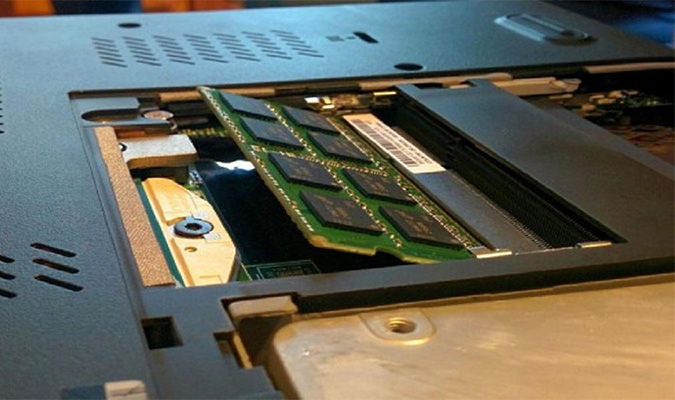
This menses of data between the disk and the RAM is controlled by the computer, which manages the writing of information to physical locations on the retentivity bit, and that information technology needs a sure amount of gratis space to function. For each program you lot run, information technology will actively apply some of the space for in-use memory and allocate some of the bachelor space as standby retention, substantially reserved space for potential operations.
In one case you hit the limit of what your RAM can concur, then your reckoner will compensate with a bandy file, putting some of the data onto your storage bulldoze. It will effort to utilise this bandy file in the same way it does RAM, constantly reading and writing the data during functioning, but the memory in your storage drives merely isn't designed to move data as speedily as DRAM. A bandy file yet lets you go some things done, but will be dramatically slower.
The lesser line is that RAM is essential to the smooth operating of your figurer, particularly for things like multitasking and accessing multiple files at 1 fourth dimension. While your overall operation will largely be dictated by the capabilities of your processor and graphics hardware, your retentivity allotment volition directly impact how well you can accept advantage of that performance. Too little RAM creates a bottleneck that slows everything down, and the bones rule of thumb is that more RAM is e'er better.
How Much RAM Exercise I Need?
The answer to the question of how much RAM you demand e'er will come up dorsum to what you desire to do with it. While opting for more RAM is always good advice, it doesn't answer the more specific questions of how much RAM is needed for specific uses, or what you can reasonably wait to practise with the RAM your laptop already has. To respond these questions we performed some testing, looking at specific utilize cases, identifying the bones retentiveness requirements for each and providing some hard numbers to dorsum our communication.
To assistance you find the best answer for you, we tested for five specific utilise cases, each common but distinct in its retention demands:
- Office productivity
- Spider web browsing
- Media streaming
- Photo editing
- Gaming
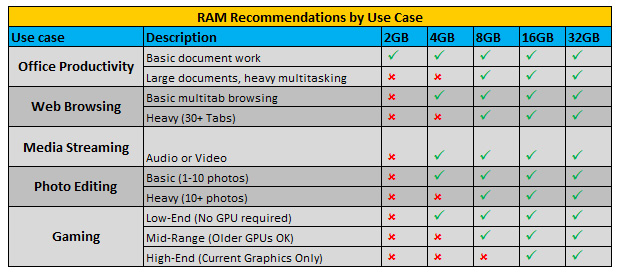
Each of these uses is mutual, but has distinctly unlike hardware requirements and memory demands. We broke down each of our five use cases, finding the memory demands for both basic and heavy use, and matched that to common allotments of RAM. Want to edit photos, but y'all're not much of a gamer? Want to exercise some document work and web browsing but nonetheless want the option to do more? Any your mix of uses, we can give y'all a very good idea of how much retention will be enough to encounter the demands of the chore.
Putting RAM To The Test
For use case testing we used an Alienware 15 R3, equipped with an Intel Core i7-6700HQ, 16GB of RAM and an Nvidia GeForce GTX970M graphics bill of fare. To obtain data on retentivity usage, we used Windows Resource Monitor, one of several tools built into Windows to view organisation data and tracking the performance of various components. We chose Resource Monitor because it provides more granular information than Windows Task Manager, just both tools are helpful for getting an idea of how memory is used every bit y'all run processes and programs.
Office Productivity
While creating and editing documents is by and large a low-resource task, office productivity gets much more enervating as you open up multiple files in multiple programs. For this test we looked at diverse programs in Microsoft's Function Suite, examining how large files stress retention equally well as using multiple productivity programs at once. If you desire to make the most of your multitasking, these are the tests to look at.
Nosotros started with smaller files in multiple programs, opening Word documents, Excel spreadsheets, PowerPoint presentations, PDF files and photos. Whether we had one Word doc open up or 10 files open across 5 programs, working with standard pocket-size documents barely exceeded 5GB of retention in apply, and never exceeded 7GB of memory in use and in standby.
MORE: Intel Hard disk Graphics Guide
Big documents were another affair. We tested with a number of documents with up of 1,000 pages. Whether looking at a single text file or a scattering of documents (Word Docs, PDF, Text files) and larger Excel files (multiple sheets, each with 100+ columns of data), the memory usage ranged between 3,283 and three,971 MB. The standby memory, however, jumped to most 10GB.
Central takeaway: Y'all tin can do a lot of piece of work with only 4GB of memory, just if yous demand to work with extremely big files, yous'll want to bump upwards to 8GB or more than.
Web Browsing
Basic web browsing can be done on near any connected device, merely loading up multiple browser tabs will use up your retention. To test the retentiveness demands of web browsing we used Google's Chrome browser, which is notable for existence both popular and a notorious retention hog. For our tests we assumed that normal browsing beliefs included the use of multiple browser tabs, with no boosted measures taken to cut down on information usage; meaning no ad blockers, no special permissions for media, and no other data-saving measures. We started with a listing of 10 popular websites then opened new tabs of these same websites in batches of 10.
This test was rather centre-opening in how clearly it showed the impact of web browsing on retentivity use. The initial x-tab test used three,333 MB of memory, with an additional 3,963 MB in standby. Those 4GB of standby memory held throughout testing, only every boosted x tabs used roughly a full GB of retention.
Key takeaway: If yous're a heavy spider web user, you lot tin go by with 4GB of RAM, but will definitely see a benefit from a larger allotment, such every bit 8GB. If your open tabs routinely hit the 30+ mark, you'll want at least 10GB of retentiveness; more than if you desire to multitask in other programs as yous scan.
Streaming music or binging on videos is a slightly different utilize case than simple web browsing, putting its ain stresses on retentiveness. We looked at both audio and video streaming, across several services, to see how much memory was impacted by video, be information technology cat videos, news clips, or high-definition movies.
Surprisingly, the overall memory demands weren't that dissimilar from regular browsing. Whether listening to multiple sound streams or watching multiple videos, the overall memory utilise didn't modify much. Single audio or video streams from Spotify or YouTube used less than 3GB of memory (ii,747 MB and 2,532 MB, respectively), and yous had to crash-land that up to 4 or more simultaneous streams to go in a higher place the 3GB mark. At that point, you're streaming an unenjoyable cacophony of sight and sound, but you lot can add together more if you want.
Key takeaway: If your chief uses for a organization volition exist streaming media, a basic 4GB should do the pull a fast one on just fine.
Photo Editing
Photo editing is far more than demanding than basic office or spider web functionality, and is usually correct on the cusp of what an affordable system can do well. We decided to test photo editing with Photoshop CC, Adobe's current offer, and used unedited photos from a smartphone, each with 5312 x 2988 resolution, and measuring v-6 MB each.
Our initial testing showed no real impact on retention usage from actual use, with niggling to no deviation between viewing open photos, merely cropping photos or performing complex edits with multiple layers. That said, equally a full general rule, Photoshop is a bit of a memory hog, and will put as much memory into stand-by as it tin can go. Adobe recommends your system have at to the lowest degree 2.5GB of RAM to run Photoshop CC in Windows (3GB to run it on Mac), but in our testing it used 5GB just to open the program and leave information technology running.
More: Which GPU is Right For Y'all
Where things really get interesting, however, is when you're working on multiple photos. Opening a unmarried photograph changed our in-use memory from 5,049 MB to 5,310 MB, simply opening ten photos bumped that up to 6,511 MB. Subsequent sets of x increased the in-use memory to vii,699 MB for xx photos and 8,828 MB for 30 images.
Key takeaway: The bottom line here is that you can use Photoshop CC with the minimum two.5GB required, only you'll see smoother performance and ameliorate photo handling with larger allotments of RAM. We'd recommend a minimum of 8GB for anyone who expects to regularly edit photos.
Gaming
Finally, there's gaming. While every gamer knows that the best gaming laptops need to accept impressive graphics and processing hardware, the place of memory in that overall equation is something of a mystery. We look at how gaming impacts retention use, what the requirements are for various current titles, and whether or non it'south worth getting memory that is optimized for gaming.
First, we tested how much memory was used opening and running a game. For this we used One thousand Theft Auto 5. Information technology's not the newest game on the market, but information technology's still relatively enervating, requiring a decent graphics card to handle all the visuals. Co-ordinate to the hardware requirements reported by Rockstar Games, you'll need at to the lowest degree 4GB of RAM to run the game, but the developer recommends a minimum of 8GB.
When nosotros ran the game on our Alienware 15, we saw that firing up Steam and opening GTAV from our games library resulted in v,324 MB of in-utilize retentiveness, with ix,319 in standby. On a 16GB organization, that'south a sizable chunk of retentivity to dedicate to a single program. Those numbers held adequately steady throughout bodily gameplay, so there's no appreciable difference betwixt running the game and playing the game that we could encounter. For this particular game, nosotros'd echo the recommendation to have 8GB of retention or more, and recall our 16GB arrangement probably hits the sweet spot for playing demanding AAA titles.
But not everything is quite then enervating, and y'all tin can detect games that will run on most whatsoever laptop out there. Low-finish gaming doesn't require much in the mode of hardware, letting you play games like Cuphead, Minecraft or Overwatch without investing in a purpose-built motorcar. These games tin can generally run on 4GB of retentivity (sometimes less), and don't require discrete graphics menu.
| Minimum GB | Recommended GB | |
| Cuphead | ii | ii |
| League of Legends | two | 4 |
| Mega Human Legacy Collection | 1 | 1 |
| Minecraft | 0.five | 1 |
| Overwatch | 4 | 6 |
| Portal two | 0.5 | 1 |
| Rocket League | two | 4 |
| Shovel Knight | ii | 2 |
| Star Wars: The Old Republic | 2 | 2 |
| World of Warcraft | 2 | iv |
Mid-range gaming may require a GPU to handle the visuals, but titles like Tacoma or Dragon Brawl FighterZ don't demand an upgrade to the latest Nvidia or AMD offerings. Retentiveness demands stay quite reasonable, running smoothly with iv-8GB of RAM.
| Minimum GB | Recommended GB | |
| Nighttime Souls 3 | 8 | 8 |
| Destiny 2 | 6 | 8 |
| Dragon Ball FighterZ | four | viii |
| Elite: Dangerous | 4 | 4 |
| Far Cry Primal | four | eight |
| For Honor | iv | 8 |
| K Theft Auto V | 4 | 8 |
| Metal Gear Solid V: The Phantom Pain | four | 8 |
| Tacoma | four | 8 |
| The Elder Scrolls V: Skyrim | 2 | 4 |
The area where you'll most desire to maximize your retentivity is current AAA titles, like Far Cry 5 or PlayerUnknown's Battlegrounds. These are games congenital to brand the most of current hardware, and a tricked out organization will need a decent amount of RAM to back-trail the loftier-end graphics and processing hardware. For this level of gaming, 16GB seems to be the sweet spot, meeting all of the retention needs for unimpeded gameplay without throwing actress money into an already-expensive organisation.
| Minimum GB | Recommended GB | |
| Far Cry 5 | viii | 8 |
| Street Fighter V | 6 | 8 |
| PlayerUnknown's Battlegrounds | 8 | 16 |
| The Witcher iii: Wild Hunt | 6 | 8 |
| Deus Ex: Flesh Divided | 8 | xvi |
| Forza Horizon iii | 12 | sixteen |
| Gears of State of war 4 | 8 | sixteen |
| Mass Effect: Andromeda | 8 | 16 |
| Prey | 8 | xvi |
| Star Wars: Battlefront | eight | 16 |
I of the other things we looked at was how memory use impacted game performance, and how much memory you might demand in social club to multitask while gaming. While most people won't be doing much photo editing in the middle of their adjacent battle royale, it'due south not uncommon to chat with friends or pull up a YouTube tutorial. So long as your gaming rig can handle the game, these simple uses should piece of work without a memory upgrade.
Key takeaway: Opt for 8GB of RAM if you want decent operation on less enervating titles, just go for 16GB if you want to play the latest and almost resource intensive hits. If yous want to do things like stream to Twitch, nosotros'd recommend opting for the 32GB options offered on many gaming PCs.
Multitasking
While these five utilize cases are all common, they're also relatively elementary in the sense that the testing focused on one or two specific uses at a fourth dimension. But what about those times you need to jump back and forth between programs, flipping back and along between files and tools? This sort of flexibility is where yous'll get the very most out of your retention, equally larger allotments of RAM facilitate exactly this sort of beliefs.
To test multitasking nosotros started by uncomplicated adding ane use case on peak of another, and ran the same test on three unlike systems: An inexpensive Dell Inspiron 11 ii-in-1 with 4GB of RAM, a mid-range Dell Inspiron 17 5767 with 8GB of RAM and the Alienware 15 R3 with 16GB of retentiveness.
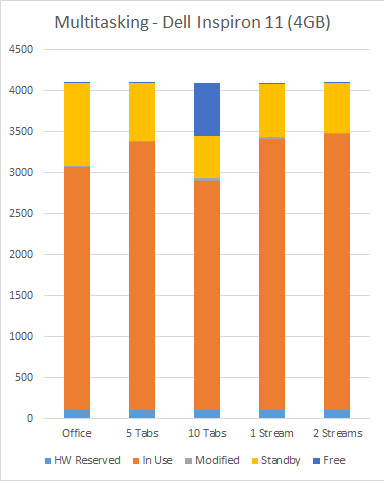
First, we started at a basic level. Nosotros opened all of our office files, maxing out the least demanding test nosotros ran. And so we opened upwardly 10 browser tabs, followed by two media streams (one audio, one video). On our 4GB system, this was enough to overwhelm the laptop, causing the organization to dull to a clamber, and basic functionality to get inconsistent. Mouse clicks failed to register, simple documents struggled to scroll smoothly, and even gathering the screenshots we used to document our testing became difficult.
Every bit we were able, we likewise ran Photoshop, with 10 photos open. We did this on both the Dell Inspiron 17 and the Alienware 15, without trouble. Photoshop is a notorious resources sus scrofa, and while you can employ it for a quick photo crop or like simple edit with 4GB, you'll definitely want a organization with 8GB or more if you await to do routine edits or piece of work on multiple photos.
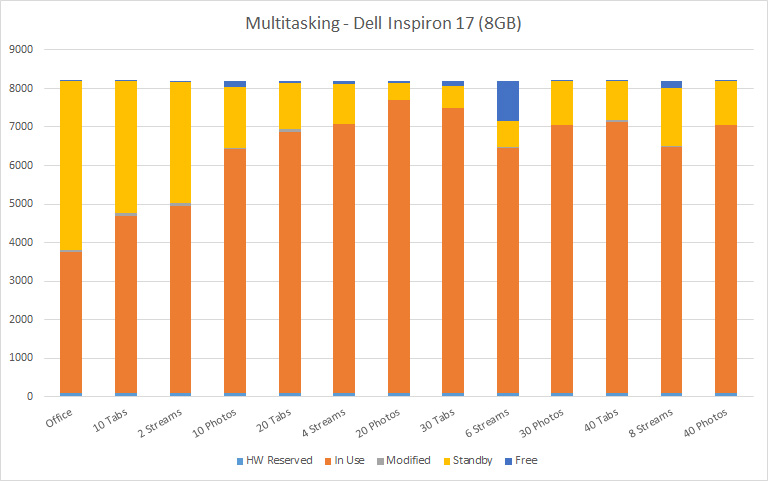
Then, on the Alienware fifteen R3, we also ran our gaming exam, using Grand Theft Auto V. While it was the only system equipped with the graphics capability needed to run the game, it was also interesting to come across how demanding the game was, specially when run in conjunction with our other tests. Just running the game uses an additional 2GB of retention, but with petty difference in retentivity load betwixt running and actively playing the game, we simply left it running for the duration of testing.
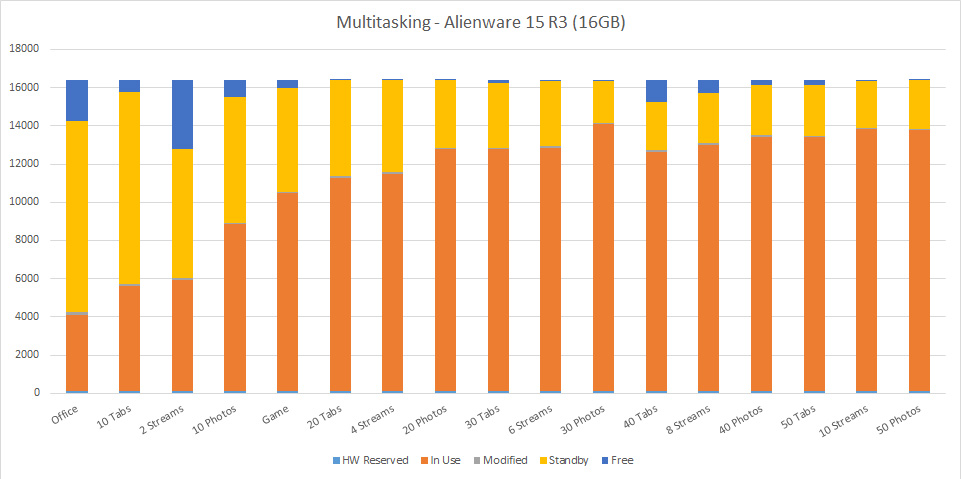
Once these baseline tests were running, we proceed to ratchet upwards the memory demands incrementally, first past adding another 10 browser tabs, then another 2 audio streams, followed by an additional 10 photos in Photoshop. The 8GB Dell Inspiron 17 continued with normal functioning. On the Alienware nosotros checked back in on GTA V and found everything running smoothly.
We did this again, bumping up to 30 tabs, 6 stream and 30 photos. Everything still worked, including the game. At this point, on both the 8GB Dell Inspiron 178 and the 16GB Alienware 15, you'll detect that the amount of standby memory changes, reprioritizing things to briefly open up additional free space.
We repeated the increasing demands, stepping up to 40 Chrome tabs, 8 media streams and xl photos in Photoshop. The Dell Inspiron'due south 8GB of memory was effectively maxed out, and in one case we hit that 8GB choke point, performance became erratic. Switching between windows became difficult and the laptop finally locked upward when we tried to open more browser tabs or photos.
The 16GB Alienware 15 held strong, just the in-employ memory approached the 14GB mark, while the amount of free memory dwindled to nearly nothing. At this point we started to run into programs deadening down, with jittery navigation and slowness in loading files as they were opened. GTA Five continued to run, and nosotros enjoyed a shootout and a machine hunt before moving on to the next level of multitasking torture.
We ratcheted up to l tabs. Then 10 media streams. Everything was holding thus far. Finally, we opened 10 more photos in Photoshop, bringing the total to 50. At this point, programs started to lock up. Windows popped in and out of view of their own accord, and our clicking and typing lagged considerably. When we tried to reopen the all the same-running game, the system locked up and refused to cooperate. With thirteen,625 MB of memory in use and 2,562 MB in standby, we had reached the limits of our 16GB of RAM. Only afterwards endmost one of our programs did part return to normal.
Key takeaway:Multitaskers should really opt for eight GB of RAM when possible, and those running multiple applications along with a ton of tabs should opt for 16 GB.
Lessons Learned
The moral of this story is pretty directly forward; you want to have more memory than you'll actually utilise. Equally you approach the limits of your memory, the impact on your productivity and user feel will exist felt more and more, right upward until you can't do much of anything. The expert news is that, as PC components go, RAM is easy to install and extremely affordable. If you want a quick mode to upgrade your laptop, adding a stick of RAM is a bully place to get-go, and is something fifty-fifty a novice can do in very little time.
The 4GB laptop striking that limit afterwards simple opening some documents and a handful of browser tabs. The 8GB organisation did better, providing proficient support for photograph editing in add-on to a healthy number of browser tabs and simultaneous media streams, while the 16GB organization supported dozens of tabs, an unreasonable number of concurrent media streams and even offered usable gaming right up to the end. Unless you plan on doing a huge corporeality of multitasking while gaming, there's lilliputian reason for most gaming rigs to get beyond 16GB of memory.
- Laptops with the Longest Battery Life
- Which GPU is Correct For You
- Which Laptop CPU is Right for You lot?
Source: https://www.laptopmag.com/articles/how-much-ram

Posting Komentar untuk "Here’s a Guide to How Much RAM Your Laptop Needs | Laptop Mag"